


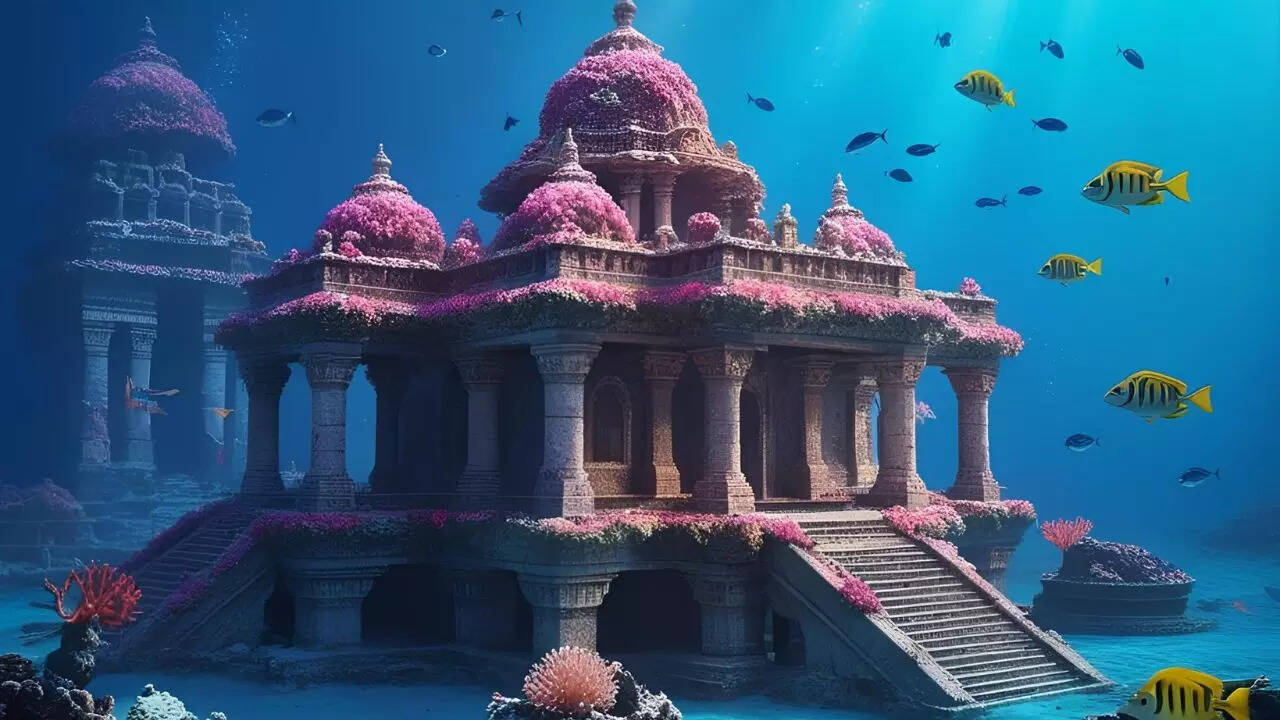
For millennia, the legendary city of Dwarka has captured the imagination of devotees, historians, and explorers alike. Revered as the divine kingdom of Lord Krishna, one of the most beloved incarnations of Vishnu in Hindu tradition, Dwarka is a place where mythology and material evidence intersect in extraordinary ways. Today, the city stands not only as a sacred pilgrimage center but also as a focus of archaeological investigation that seeks to uncover a chapter of ancient Indian civilization buried under the Arabian Sea.
📖 Mythology & Scriptural Foundations
According to ancient Hindu scriptures — especially the Mahabharata, Bhagavata Purana, and Harivamsa — Dwarka was founded by Lord Krishna after he left Mathura. In these texts, Krishna chooses a coastal site in present-day Gujarat, transforming it into a magnificent fortified city that served as the capital of the Yadava dynasty.
The spectacular descriptions of Dwarka’s palaces, gardens, wide streets, and grand fortifications reflect not only its political importance but also its spiritual prominence. The Mahabharata narrates that after Krishna’s departure from the mortal world, Dwarka and its inhabitants were engulfed by the sea, a cataclysmic event symbolic of the transition into Kali Yuga — the age of discord and decline.
In religious tradition, Dwarka is also part of the Sapta Puri — the seven most sacred pilgrimage sites in Hinduism — and forms an integral element of the Char Dham circuit, revered for granting spiritual liberation (moksha).
📍 The Geography of Ancient Dwarka
Dwarka is located on the western tip of the Okhamandal Peninsula along the Gujarat coast, near the mouth of the Gomti River where it meets the Arabian Sea. Today’s city of Dwarka stands on what is believed to be the heritage site of Krishna’s ancient capital. Adjacent to it lies Bet Dwarka, an island traditionally regarded as Krishna’s actual residence, where many temples dedicated to Krishna and his companions testify to the region’s deep religious history.
The vibrant culture of prayer, festivals like Janmashtami, and festive pilgrimages draw millions of devotees every year — a testament to Dwarka’s undiminished spiritual magnetism.
🏛️ Modern Dwarka: Temples & Pilgrimage
Central to the spiritual landscape is the Dwarkadhish Temple, dedicated to Krishna as the “King of Dwarka.” While archaeological evidence suggests the earliest structures may date back to several centuries BCE, the temple has undergone numerous renovations and reconstructions through the centuries.
In addition to Dwarkadhish Temple, the region is dotted with other significant sacred sites:
- Rukmini Devi Temple: Dedicated to Krishna’s principal consort, reflecting ancient lore and architectural elegance.
- Shri Keshavraiji Temple in Bet Dwarka: One of the oldest centers of devotion dedicated to Krishna.
These sites, coupled with the devotional rituals practiced by pilgrims, reinforce Dwarka’s role as a living spiritual hub where ancient beliefs and community practices flourish.
🧭 Archaeological Exploration: Myth Meets Material Evidence
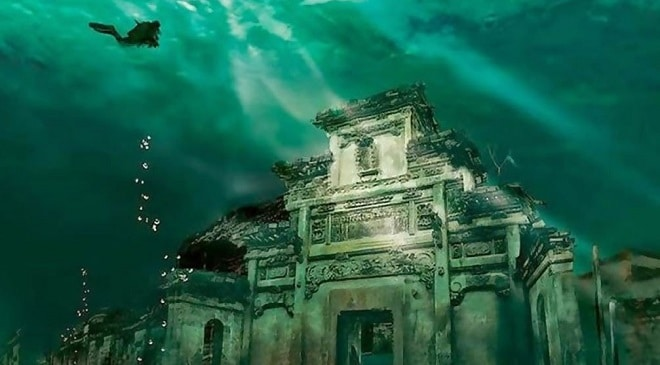
For decades, the belief in a sunken Dwarka remained within the realms of mythology and folklore — until modern science began probing beneath the waves. Marine archaeological surveys off the Gujarat coast have revealed submerged structures, stone anchors, pottery shards, and architectural fragments that suggest the existence of a once-flourishing coastal settlement.
Early Discoveries & S.R. Rao’s Expedition
In the late 1980s and early 1990s, pioneering Indian marine archaeologist S.R. Rao led several underwater explorations near Dwarka. These investigations identified stone walls, structural blocks, and other artifacts submerged beneath the Arabian Sea — indicative of organized urban planning. Some dates from recovered materials pointed to ancient habitational layers that correlate with periods described in historical and scriptural timelines.
Structural Evidence
Sonar surveys and underwater dives have uncovered remnants of large stone structures and man-made formations off the coast of modern Dwarka. These submerged features lie at varying depths — often between 6 to 40 meters — and include building blocks, possible roadways, and other traces of human settlement.
Some research even suggests that underlying deposits could date back to the Harappan era or earlier, hinting at a civilization that thrived long before conventional historical timelines.
🌊 Why Did Dwarka Submerge?
The reasons behind the submergence of ancient Dwarka remain complex, blending geological, climatic, and mythic narratives. Several possibilities are considered:
- Natural coastal changes: Shifts in sea level, subsidence of land, or tectonic activity could have gradually inundated the low-lying coastal region.
- Cataclysmic flooding: Ancient texts describe dramatic events connected with Krishna’s departure, often interpreted metaphorically or symbolically to signify endings.
While the exact cause remains a subject of debate, the archaeological evidence confirms that significant human settlements once existed near the present shoreline — some of which may have been submerged over time.
🔍 New Research & Ongoing Excavations
In recent months, the Archaeological Survey of India (ASI) has announced plans for renewed and deeper excavations, both on land and underwater, to investigate previously unexplored areas of the Dwarka region. These efforts aim to gather more comprehensive data using modern technology to better understand the city’s ancient past and its connections to the Krishna legends.
The use of advanced marine survey equipment, sediment analysis, and underwater mapping could potentially provide new insights into the extent and organization of ancient Dwarka.
🧠 What Scholars Believe vs. Mythic Interpretations
The debate around Dwarka’s historical reality involves scholars from different disciplines:
- Traditionalists emphasize the strong alignment between scriptural descriptions and archaeological features.
- Conservative archaeologists argue that while underwater ruins reflect human settlement, directly equating them with Krishna’s mythical city requires caution.
- Some researchers suggest the city was once a thriving maritime port long before historical records, possibly dating as far back as the late Harappan period or earlier.
Thus, Dwarka occupies a unique zone between faith and empirical inquiry, inviting both devotion and scientific curiosity.
💫 Dwarka in Spiritual Consciousness
For devotees worldwide, Dwarka is not merely an archaeological site but a living embodiment of Krishna’s life and teachings. Pilgrimages to Dwarkadhish Temple, celebrations of Krishna Janmashtami, and ritual practices all reinforce a deep spiritual connection that transcends empirical evidence.
At its core, Dwarka symbolizes divine governance, eternal friendship, and the cyclic nature of life and time — themes that resonate deeply in Hindu philosophy.
🌟 Visiting Dwarka: Pilgrimage & Experience
Today, pilgrims and travelers can explore both the spiritual and cultural heritage of Dwarka:
- Dwarkadhish Temple — The focal point of devotion and worship.
- Bet Dwarka — Island retreat linked with Krishna’s earthly life.
- Rukmini Devi Temple — Honoring Krishna’s queen and her spiritual significance.
Sunset views over the Arabian Sea, evening aarti ceremonies, and the rhythmic chants of temple bells all contribute to an experience that blends history with living tradition.
🧡 Conclusion: The Legendary Lost City
Dwarka is arguably one of India’s most intriguing intersections of myth, history, and archaeology. Its mention in ancient scriptures, combined with underwater discoveries and ongoing explorations, makes it a subject of international fascination. Whether viewed through the lens of faith or science, Dwarka’s story continues to challenge and expand our understanding of ancient civilizations.
For spiritual seekers, historians, archaeologists, and curious minds alike, Dwarka remains a city of profound mystery — where the echoes of Lord Krishna’s legacy still ripple through time and tide.