


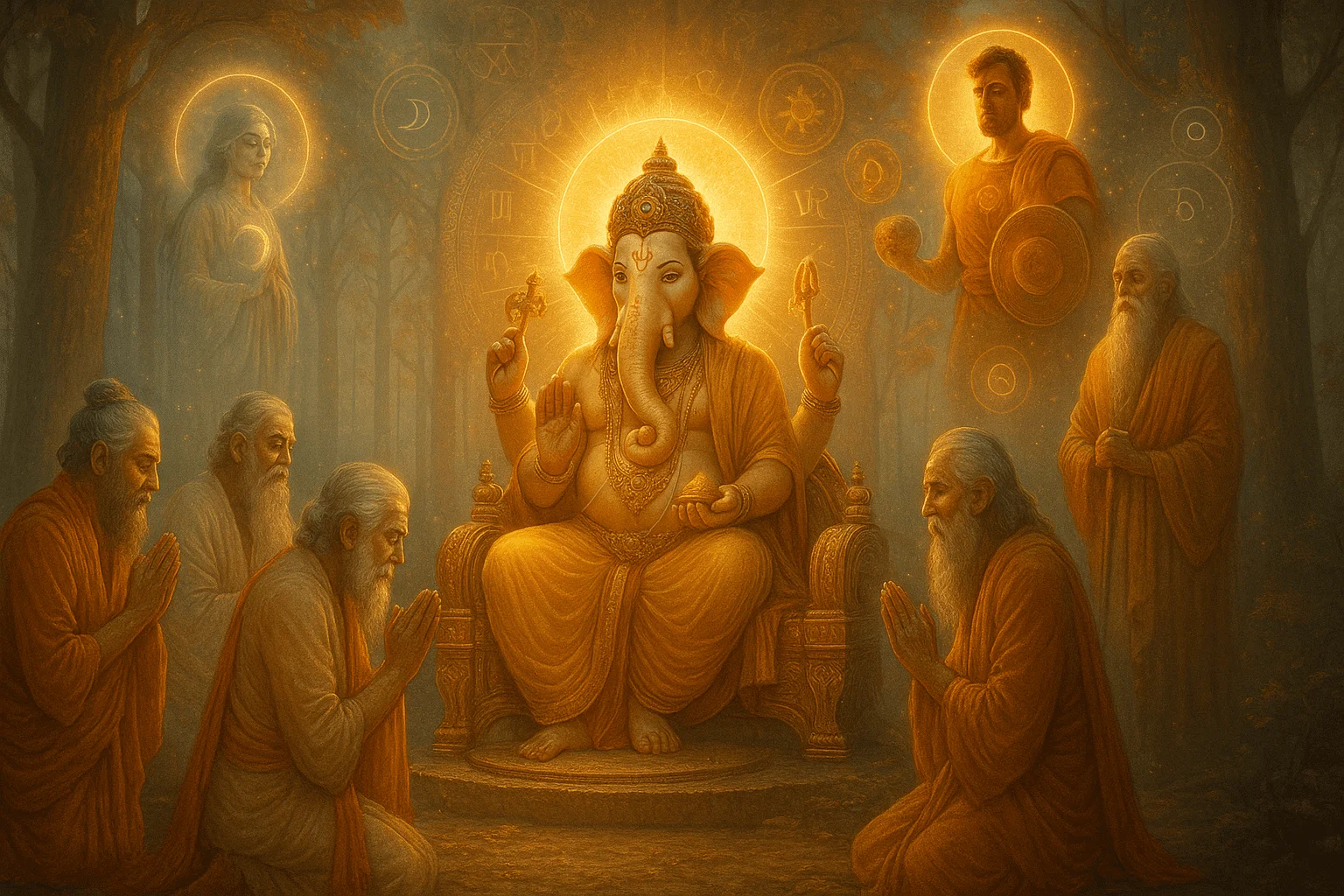
Lord Ganesha stands among the most universally revered deities in Hinduism — worshipped as the remover of obstacles, the bringer of prosperity, the god of intellect and wisdom, and the beginning of all auspicious ceremonies. Across centuries, his cosmic symbolism has also deeply influenced Vedic astrology (Jyotish), shaping spiritual practices, remedial rituals, and the way people understand destiny, karma, and cosmic intelligence.
In this detailed article, we explore Lord Ganesha’s divine essence, his astrological connections, his role in human life, and why worshipping Ganapati is considered essential before starting any spiritual or material enterprise.
Who is Lord Ganesha?
Lord Ganesha — also called Ganapati, Vinayaka, Vighnaraja, and Vighnaharta — is the elephant-headed son of Lord Shiva and Goddess Parvati. He is widely worshipped across India and beyond as the Lord of Beginnings and the Remover of Obstacles.
Unlike many deities whose roles are singular, Ganesha’s attributes are multifaceted:
• Wisdom and intellect
• Success and auspicious beginnings
• Removal of spiritual and material obstructions
• Cosmic balance and karmic understanding
• Protection and good fortune
Ganesha’s distinctive elephant head symbolizes vast intelligence and the ability to think beyond the limits of ordinary thought. His large ears represent attentive listening and learning, while his trunk signifies adaptability, strength, and discriminative intelligence.
Ganesha and Vedic Astrology: A Deep Connection
While Ganesha is popularly known for removing obstacles, his relationship with Vedic astrology (Jyotish Shastra) goes much deeper — to the heart of how destiny, karmic cycles, and cosmic energies are interpreted.
1. Ganesha as the Cosmic Intelligence
According to Vedic tradition, Ganesha is not just a mythic figure — he embodies cosmic intelligence and Mahat Tattva, the universal principle underlying all creation and order. In this sense, he represents the source of universal laws, much like how astrology seeks to decode the cosmic influence on human life.
Astrologically, he is considered the ruler of Ketu, the south lunar node (a shadow planet associated with spiritual liberation, detachment, and subconscious energies). Worshipping Lord Ganesha is believed to help pacify the challenging influences of Ketu, bringing clarity and grounding.
2. Ganesha as the First Deity in Astrology Rituals
In classical Hindu rituals and astrological practices, Ganesha is invoked before beginning any significant event — including birth chart readings (kundli analysis), muhurat calculations, astrological remedies, education, business ventures, and important life transitions.
This tradition is rooted in the belief that Ganesha helps clear both internal and external obstacles that could obstruct the proper interpretation or application of astrological insights.
3. Symbolism Linked to Astrological Traits
Every aspect of Ganesha’s form has symbolic value in astrology:
• Elephant head — symbolizes expansive intelligence and higher consciousness.
• Single tusk (the other broken) — signifies the ability to overcome duality, focusing on wisdom.
• Four arms — represent four parts of human existence: mind, intellect, ego, and self.
• Mouse (his vehicle) — symbolizes humbleness, the conquest of ego, and the ability to journey through subtle layers of the psyche.
This deep symbolism reflects how astrology views the human psyche — not just as physical existence, but as a composite of cosmic energies and karmic lessons.
Ganesha in Karmic Astrology
Astrology doesn’t just map planets; it interprets how cosmic forces influence life paths, challenges, and growth. In this context, Ganesha is seen as a guide who helps the soul navigate the karmic terrain — whether removing obstructions (Vighnas) or guiding aspirants toward higher consciousness.
1. Remover of Obstacles and Karmic Blocks
Ganesha is popularly invoked to remove physical and spiritual hurdles. In astrology, planetary afflictions, especially from shadow planets like Rahu and Ketu, can create confusion, delays, and emotional turbulence in a person’s chart. Worshipping Ganesha is believed to help mitigate those influences, bringing clarity and focus.
2. Enhancing Wisdom & Mental Clarity
Astrologers often recommend Ganapati worship to strengthen Budhi (intellect) and Vivek (discernment) — key factors in astrological interpretation and decision-making. Ganesha is therefore seen as a deity who stimulates the mind and enhances intuitive understanding of planetary cycles.
3. Influence on Birth Charts
While there is no formal “birth chart” for Ganesha in Jyotish (since deities transcend human timelines), traditional interpretations symbolically associate him with Muladhara Chakra (root) — representing stability, grounding, and life-force energy.
Ganesha’s Spiritual Role Beyond Astrology
Lord Ganesha’s influence goes beyond astrological symbolism to touch many aspects of spiritual and day-to-day life:
1. Beginning of Auspicious Work
Hindus traditionally begin any new endeavor with prayers to Ganesha — whether it is a business, ceremony, or ritual — to secure success and remove potential blockages.
2. Festival of Ganesh Chaturthi
Ganesh Chaturthi, celebrated during the Shukla Paksha of Bhadrapada month, is one of Hinduism’s most popular festivals. It honors Ganesha’s birth and is a time when devotees seek his blessings for wisdom, prosperity, and removal of obstacles.
3. Ganesha in Daily Worship & Rituals
In astrology consultations, priests often recommend specific remedies involving Ganesha — such as chanting “Om Gan Ganapataye Namah”, offering modaks, and performing Ganesh pooja before muhurat calculations.
Astrological Remedies with Lord Ganesha
Astrology isn’t merely predictive; it proposes remedies. Many astrologers prescribe Ganesha-focused rituals to balance planetary disturbances:
• Chanting the Ganapati Mantra (108 times) to strengthen intellect and remove blockages.
• Offering modaks / laddus — considered Ganesha’s favorite — for prosperity and harmony.
• Performing Ganesh Pooja before astrological remedies for Rahu/Ketu pacification.
• Lighting lamps and chanting during Sankashti Chaturthi for clarity and emotional balance.
Such rituals are believed to help align personal energy with the cosmos, balancing karmic influences and refining intuition.
Why Astrologers Invoke Ganesha First
In Vedic astrology, no reading or muhurat calculation begins without invoking Lord Ganesha. This reflects an inherent belief that spiritual intelligence must guide cosmic interpretation — that understanding destiny isn’t purely analytical, but inherently spiritual.
Ganesha is thus seen as the bridge between cosmic forces and human consciousness, ensuring that astrological insights benefit the seeker without interference from mental obstructions or karmic noise.
Conclusion: Ganesha — The Cosmic Guide
Lord Ganesha’s significance transcends mythology, ritual, and cultural celebration — he symbolizes the union of cosmic intelligence, spiritual wisdom, and karmic clarity. In the realm of astrology, he is more than a figure of worship — he embodies the principles that make Jyotish a guide to life’s deeper meanings.
Whether you seek success in your personal endeavors, clarity in your birth chart interpretation, or harmony with the cosmos, Ganesha’s presence in astrological practices strengthens intuition, removes obstacles, and brings profound understanding.